Thursday, September 08, 2005

September 8th - Final Posting

For those who have been following our adventure drive through southern Africa, you will know that we were unable to post as many photos as we were hoping to, while we were driving.

Now, we have completed posting the photos to this website. We have added photos to virtually every day of the tour. We hope these add to the enjoyment of reading about The African Adventure. They certainly bring back wonderful memories to us of a 'trip of a lifetime'.

We understand that plans are progressing for HERO 4x4xplore to have an adventure drive in Central America, in autumn of 2006. If that goes ahead we will be there!

Saturday, September 03, 2005

September 1st - Day 29

Well, this was it, the last day of the African Adventure 2005. The month had simply flown by and now we had to say our goodbyes to both old and new friends.
What an adventure it had been! When we signed up last October, we both thought it would not be possible to match the Great China Tour that John and Joanna Brown organised in April/ May 2004. Well, how wrong we were!
We never realised how beautiful southern Africa could be. The tourist guides, magazine articles and TV programmes simply cannot convey the beauty of the place. Added to that are the animals. To see so many different animals in their natural surroundings, such as in the national parks of Etosha, Chobe and Kruger, is a real joy. It just didn't cross our minds that we might see herds of elephants drinking at the Chobe River in Botswana and a pride of lions walking in single file down a road in the Kruger National park a few feet from us. Again, the thought that we would be just yards from a herd of buffalo standing around a dead elephant as the vultures flew down and a lone lioness attempted to feed off the carcass, and failed, never occurred to us before we left England.
These were but a few of the amazing moments from the tour that we will remember and enjoy when we look at the six hours of video and nearly a thousand photos that we have taken.
Southern Africa is a place that we never thought of visiting before the African Adventure. Now that we have completed the tour we can't wait to return.
As our plane took off from Cape Town International airport we both felt privileged to have been able to participate in such a wonderful adventure.

August 31st - Day 28

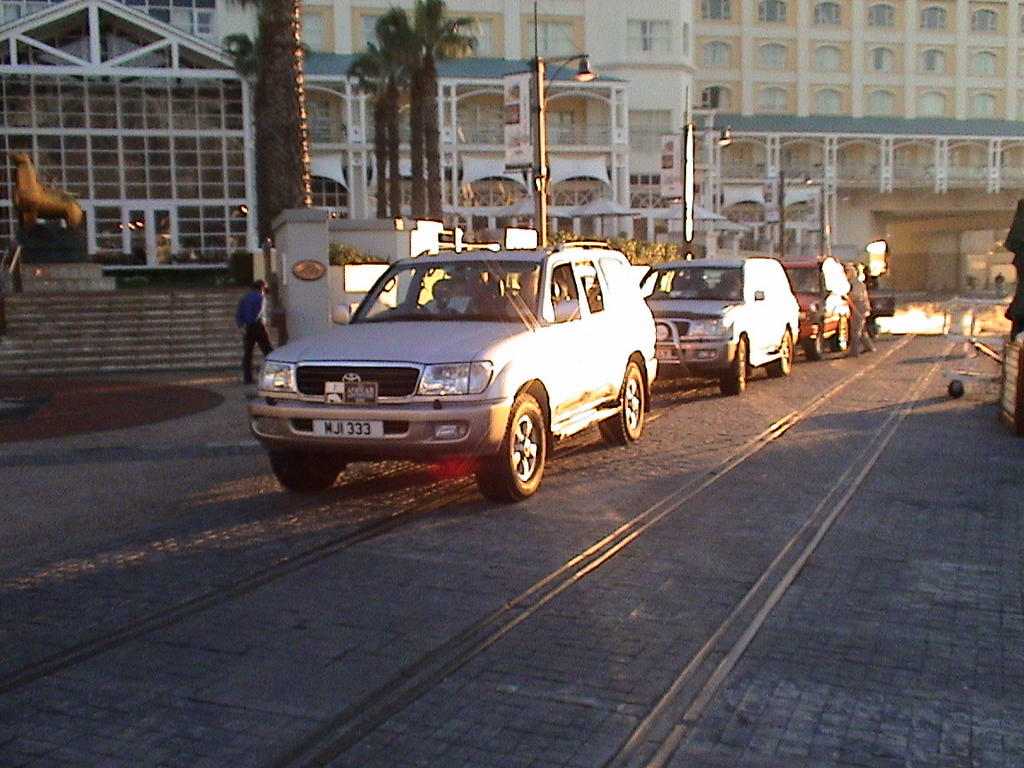
Five star luxury! The Table Bay Hotel, on the waterfront in Cape Town is, for my money, one of the best hotels in the world. To start and finish the tour in such a great place certainly adds 'the icing to the cake', and is the perfect place to wind down after a month's tour of southern Africa.
We both feel that our decision to drive directly from Vredendal to Cape Town was the correct one. We have been able to empty the car of everything, ready for shipping back to the UK tomorrow, as well as enjoying a chance to visit places in Cape Town we were unable to look at when we arrived at the beginning of August.
The weather has remained overcast and with the top of Table Mountain shrouded in clouds there was no point in taking the cable car to the top. Still, we were able to use the car for one last drive round Cape Town. We looked at the Mount Nelson Hotel, a famous traditional hotel, then on to see the cable car station with great views over Cape Town and the harbour.
We then drove around Table mountain to visit the Rhodes Memorial, set in gardens on the slopes of the mountain. Rhodes died in 1902 and the memorial to him is a very gaunt looking affair. Great stone columns support a roof over the bust of Rhodes. The bust is only in sight when standing directly in front of the memorial, otherwise the columns hide it from view. Eight giant lions line the steps leading to the memorial and a very classical looking statute of a man on horseback is at the the foot of the steps.
We then took a short drive to the world famous botanical gardens at Kirstenbosch. We were delighted we decided to go there. The gardens are very beautiful, with every conceivable plant on display. The conservatory has a very informative display of desert and arid plants with detailed explanations of the how the plants have adapted to survive in very dry environments. It was good to learn the names of so many plants that we recognised from the tour.
We then had to head back to the hotel to get ready for the official finish at 3pm. When we arrived we met up with those who had stayed the previous night in Ceres, and for the next couple of hours the remainder of the cars finished the tour.

The Finish on the Waterfront at Table Bay Hotel, Cape Town
At 3pm the cars lined up in order of their entry number. We went over the line, after the de Hullu's and Mark I'Anson and family in their Landcruiser. A band played as John Brown waved the finishing flag as each car crossed the line. Champagne flowed as everyone congratulated each other on successfully completing the tour. It was a great party as photos were taken of the participants and their cars.
Car No.1 crosses the finishing line
Antoine, Maria and Victor de Hullu
Car No.9
Jean Steinhauser and Anne Collard
Car No.23
Jim, Leejun & Kaitlyn Taylor
The 'Advance' Car team, Arne and Ingbritt Hertz
Car No.22
John and Elaine Chambers
Car No. 4
Jim Carr and Helen Peacock
Celebrating the finish on top of the de Hullu's Landrover
Car No.8
Stuart and Sheri Jamieson
Car No.11
Michael Bernecker and Mara Schemmann
Car No.10
Geoffrey and Veronica Poxon
Two hours later and we were taken in two coaches to the end of tour party at Boschendale, a winery near Stellenbosch. John Brown spoke about the tour and then each participant was called up to collect their 'prize' for completing the tour; a beautifully carved giraffe for each woman and a rhinoceros for each man.
The evening finished with the music being turned up loud and dancing the night away. Tomorrow the car goes back to the car delivery depot, some thirty kms from Cape Town and then we fly back to the UK on the 8pm BA flight to Heathrow. All very sad.
Photos will be added very shortly after the return to London

Tuesday, August 30, 2005

August 30th - Day 27

Well this was it, the final day of driving for us on the Hero 4x4xplore African Adventure.
Only 300 kms to go to Cape Town, so a late start was possible. Three other cars were doing the same and missing out on the stop in Ceres. They were, Geoffrey and Veronica Poxon in Richard Smith's Landcruiser, Jim Carr and Helen in their orange coloured Discovery and John and Elaine Chambers in their Landcruiser.
As we crossed the Oliphants River in Vredendal we saw the damage being done by the recent heavy rains that have affected Western Cape. The river has burst its banks and the vineyards on either side are completely flooded.

Flooded vineyards on the banks of the Oliphants River

As we passed the small town of Clanwilliam we saw the water pouring over the sluice gates at the top of the Clanwilliam Dam. Four huge torrents of water were cascading down the dam into the river below. As we passed the dam we saw how huge the lake behind was. You could see large areas of farmland were now under water.

Clanwilliam Dam, with water pouring over the top
About 80 kms further on and we approached the magic 10,000 kms on our tripmeter. We took a photo of the GPS as 9,999 was reached and then 10,000!! What a trip it has been for us both.

GPS at 9,999 kms about to click up the 10,000 kms mark

The drive back to Cape Town was uneventful and it was disappointing that the weather, which has been uninterrupted sunshine for the past three weeks, should now turn and the hoped for good views of Table Mountain were completely blanked out by dense cloud and rain.
Still, the exhilaration at having successfully completed the tour outweighed any disappointment about the weather.
Champagne was the order of the day as we celebrated in the hotel with John and Elaine.
The rest of the tour will arrive tomorrow lunchtime and we all 'officially' finish the tour at 3pm tomorrow afternoon.
In the evening we met up again with Arne and Ingrit Hertz and they joined all four 'finishers' for a great seafood meal in the mall alongside the hotel. A fitting way to end the day.
It looks like I will not be able to post more photos till we return to London on Friday. I hope to have them on the site by the end of next week.

August 29th - Day 26

Even though it was going to be one of the longest drives of the tour we couldn't get away early as we had to wait till the tyre repair shop opened at 8am. The repair was quickly done and we headed off at the end of the pack.
The drive to the border with South Africa of 300 kms was over wide open plains with the road stretching out in front of us to the horizon. These virtually empty, straight roads of Southern Africa have definitely been one of the things we will remember from the tour.
We crossed into South Africa at the Orange River. It was interesting to see that the hills on the banks of the river were the same colour as the sand in the Namibian dunes. We were hundreds of kilometres to the south of the dunes and now we could see the source of all that sand.


The Orange River at the border between Namibia and South Africa


Once back in South Africa we had one more place of interest to see before our overnight stop at Vrenendal, the Namaqaland National Park. This park is famous for the wild flowers that bloom in the spring. We were not to be disappointed. Our first view of the flowers were patches of orange and yellow flowers alongside the road. But nothing could prepare you for the blaze or orange that carpeted large fields in the park. The predominate colour from afar was orange, but as you got closer yellow, white and blue flowers could be seen.

The spring flowers in Namaqaland National Park, Western Cape, South Africa

It was a wonderful sight. We took the 7 kms drive through the southern end of the park. Afterwards we learnt from other members of the tour, who had driven from the northern park entrance, that the southern area of the park was by far the best.


We had a very good snack lunch in the park and then drove the final 200 kms to our hotel arriving at 5 pm.
We have decided to drive directly to Cape Town tomorrow rather than staying with the tour who will stop for the night in the citrus capital of South Africa, Ceres. This will give us an extra day to see Cape Town which we lost at the beginning of the tour due to the SAA strike.
It will be sad to be on our last day of driving. We have now covered 9,920 kms in twenty-six days, much of it tough, but all of it the greatest of fun.

August 28th - Day 25


A lovely late start as our route to Fish River Canyon was only 160 kms, with the fist 50 kms on tarmac and the remainder on good fast gravel to the Fish River Canyon.
Along the road, in the telegraph poles, weaver birds had constructed their giant communal nests. It made an interesting sight and I was left wondering how they manage to fix the first few bits of straw to the pole.

Weaver bird nest in telegraph pole

At the park entrance we paid the entrance fee of 170 Namibian dollars, equivalent to fifteen pounds, and drove the final 10 kms to the viewing point overlooking the canyon.
You have to go right up to the edge of the canyon before you can look down to the river. The sudden sight of this truly massive chasm, that snakes its way across the dry barren landscape, is very impressive. The canyon is up to 500 metres deep and 25 kms wide. The rive snakes its way around large rock pinnacles in a series of meanders. At this time of year the volume of water is a fraction of that after the summer rains. Fish River Canyon, with the river 500 metres below us
We spent several hours at the canyon, viewing it from different points on the canyon rim. We then drove back to a small restaurant just outside the park entrance for a light lunch. When we got there we met up again with some of the group who had stayed the previous night in Luderitz. We exchanged news about the two different routes we had taken before driving back to our hotel in Keetmanshoop. In the car park of the restaurant was this old wreck. I liked the cactus growing out of the engine space!
On the way we overtook a cart with half a dozen local people, being pulled by two donkeys. With only a few days left of the tour we had been wondering what to do with our emergency rations of food - cans of baked beans, tinned fruit, packets of soups etc. Seeing these Namibians on the cart, it suddenly occurred to us that this was the ideal opportunity to find a good home for our food supplies. The look of astonishment on their faces as we gave them all our rations, was priceless.
We arrived back at our hotel around 5pm. Just before going to supper I decided to check the car and found that we had another puncture, the third of the tour. Two other cars also suffered from punctures today. The gravel roads are not the best surface for tyres, even when you have the tough 'all terrain' type that we use. I changed the wheel for one of the two spares that we carry and decided to have it repaired in the morning before driving the 800 kms to Vredendal, a town in the wine growing region of Western Cape just 300kms north of Cape Town

August 27th - Day 24

Another change to the route. Late last night we agreed with John and Elaine Chambers to miss out on going to the Germanic town, Luderitz, on the Atlantic coast, and go to Keetmanshoop where the tour will be stopping in two days time, for one night only.
We will stay there for two nights so that we have a full day to see one of the highlights of the tour, Fish River Canyon. We will also reduce the distance we need to travel over the next two days by 150 kms.
Back to today's route. Everyone was up early to drive about 60 kms to see incredible Namibian sand dunes at Sossusvlei, an area about 100 kms from the sea.

The beautiful sand dunes of Nambia, definitely one of the highlights of the tour

The sand dunes which now stretch for hundreds of kilometres along the Atlantic coast have been created by sand that has been washed down to the sea by the Orange River, 1,000 kms to the south. Sea currents have then carried the sand along the coast and finally the wind has created the dunes. They are the most stunningly beautiful sight you can imagine. Great waves of sand, in a myriad of different colours, that rise hundreds of feet to their peaks. Sharp ridges form on the edge of each dune, that snake their way to the tops, creating wonderfully graceful lines. The colour, every shade of orange and red imaginable, is quite different on the sunlit side to the area in shadow.
There is a parking place by a dune called Dune 45. It is a hard walk up the dune but then a fast run down the side!

Dune 45 with members of the tour climbing to the top


We spent a couple of hours in the dunes before heading south for our lunch stop at a castle, in the middle of nowhere, built by a German count and his American wife in 1909. Duwisib Castle is now a national monument and is being restored. It stands in the middle of the African countryside as a statement to Germanic military might. It is the last thing you expect to see!

Duwisib Castle, Namibia

From Duwisib our route south-east took us away from the tour which headed for Luderitz.
How lucky we were to have made the decision to go a different way. The road for the next 200 kms was through the most spectacular scenery, We rose to over 1,800 metres and climbed into a region that is virtually uninhabited. On the whole journey we only encountered five cars and none of them going our way! Great plains that have been cut up by rivers and flat topped mountains stretched into the distance. Definitely, Africa is the most wonderful place,
The final 100 kms was on they smoothest gravel you could imagine, an, added bonus to the journey. We then met the Ludertitz to Keetsmanhoop road and within an hour we were at our hotel.
We were delighted to meet up with the 'advance' car driven by Arne and Ingbrit Hertz. They have been doing the route one or two days in advance and reporting back on any route changes. It ensures that we are able to keep to our very tight and, at times, hectic schedule.
A day at Fish River Canyon tomorrow which is about 160 kms south of Keetmanshoop.

Saturday, August 27, 2005

August 26th - Day 23


Over three quarters of the tour completed and 8,200 kms driven. We are now in the final part of our wonderful adventure drive round Southern Africa. Six countries visited, every day fantastic scenery, wonderful wildlife and a great group of like-minded people to travel with. We couldn't have asked for more.
We spent a couple of hours looking at Swakopmund and doing some shopping. Swakopmund is a very lively and prosperous place and was quite crowded as it was Heroes' day. This national holiday celebrates the heroes of the struggle for independence and commemorates the first shot which was fired on the 26th August 1990.

Germanic architecture in Swakopmund

We both bought seal skin shoes which are very comfortable and hard wearing. Our drive today then took us south-east to the Sossusvlei Lodge in the Namib-Naukluft Desert. First we drove south to Walvis Bay, named for the whales seen there when the first Europeans came here in the 15th century. We had our first view of Namibia's great sand dunes. Massive hills of reddish sand ran alongside the coast road and in places people were para-sailing and sand buggying up and down the sand.

First view of Nambia's fantastic sand dunes - the highest in the world

At Walvis Bay, an unremarkable town, we turned left into the desert. 150 kms of stunning gravel road rising up to 1,000 metres as we drove due east.
The road across the Namib Desert from Walvis Bay

As we rose over one of the many slight rises in the road we came across a group of people standing in the road with their car upside down on the roadside. Fortunately no one was seriously hurt but it shows how careful you have to be when driving on gravel which can be very slippery. They were getting help from a tour bus that had stopped. so we didn't need to give any assistance.

The overturned saloon car on the road from Walvis Bay


The desert scenery will never fail to impress me. I always have a feeling of insignificance when I am in such a harsh and vast wilderness. The wonderful colours that change as the sun moves in the sky, ensures the journey is never the least bit uninteresting. As we approached the sign marking the Tropic of Capricorn we used our GPS to exactly pin point the position on the road where the Tropic was located. According to the GPS it was about 15 metres north of the sign. Having left the tropics our drive continued south to the isolated desert resort of Sossusvlei.

The individual units we stayed in were half building and half tent. Quite unusual, but fun, especially as the desert wind rose after the sun had set and the wind howled through the tent above our bed.

The half house and half tent accomodation at Sossusvlei Lodge

As the sun set over the desert hills we watched as the stars appeared. There is nothing like a clear desert night sky. Thousands of stars blanket the sky with the Milky Way a beautiful white band crossing from horizon to horizon. It is a magnificent sight and one we have lost in most, if not all, of the UK through air and light pollution.
Only five days to go now, with two more in Namibia before we reach the border with South Africa and the final part of the tour to Cape Town.

Thursday, August 25, 2005

August 25th - Day 22

As I said yesterday the tour is now heading almost due south and today's drive took us along wonderful fast straight tarmac and gravel roads to the Atlantic coast of Namibia and then to our hotel in Swakopmund.
There were two route options in the road book. The first was for those who wanted to tackle a difficult 4 x 4 section of mountain track and the second taking mainly tarmac roads through the Namib Desert to Swakopmund. We decided it was time to tackle a good 4 x 4 route as we had, up to now, opted to either take the main roads or to go on a different route altogether.
We set off at six o'clock on more of these incredibly straight Namibian roads. It will be very difficult getting used to the UK roads after Namibia! After about 150 kms we took the first section of gravel road to see an impressive rock formation called Finger Rock. This massive column of rock, created by wind and water erosion, stands hundreds of feet above the surrounding countryside.

Finger Rock, Namibia

The area here was very reminiscent of Monument Valley in the USA, with great flat topped mountains.
A bit about driving on gravel roads. On these roads the dust thrown up by a car is quite unbelievable. It is extremely difficult to pass a slower car, as you are driving 'blind' when you are about to overtake. It makes for very tiring driving. The dust gets everywhere and no matter how hard you try to stop it getting in to the car a fine layer soon settles over everything.
The further I go without the car suffering any mechanical failures the more concerned I become that something might go wrong. So, when we started the rough 4 x 4 section I began to worry this might be the day the car would let us down. I shouldn't have worried. Even though the going was extremely tough with deep ruts, boulders all over the place and steep uphill sections of track, the car once again proved how tough it is.

Jean Steinhauser and Anne Collard in their Landrover Defender on a very steep section of track

Once through the 68 kms of rough track we flew down the 75 kms to the sea. We were now in the magnificent Namib Desert, one of the driest places in the world.

The magnificent wilderness of the Namib Desert

The road was wide smooth gravel and we averaged 120 kph with ease as we slowly descended to the sea. Stunning desert scenery was all around us.

Long straight roads leading to the Atlantic coast of Namibia. Not a sign of life anywhere!

Then we had our first sight of the Atlantic and the infamous Skeleton Coast. So called because so many sailors have lost their lives in ship wrecks along this coast, mainly because of the fogs that occur along the coast due to the cold Atlantic water that comes up from Antarctica. It was said that it was better to drown than survive by making it to the shore and then to die of thirst.
We were now only 150 kms from our destination. The road here is called a 'salt' road which is made by spraying salt water on the sand. It then dries out, creating an incredibly smooth surface. We ran alongside the sea to our right and the desert stretching away to our left.
About halfway we stopped at Cape Cross seal colony, where apparently an estimated 100,000 to 200,000 grey seals live. It is an incredible sight to see so many crowded together on the beach. The noise they make is quite astonishing, as is the smell!

Cape Cross Seal Reserve on the Atlantic coast

An hour later and we were at the hotel and five star luxury after the rough tracks, gravel roads and the wilderness of the desert. It was wonderful! I was delighted to learn that everyone who had tackled the 4 x 4 section had made it safely. More desert tomorrow as we continue south.

Swakopmund Hotel, a converted railway station

Wednesday, August 24, 2005

August 24th - Day 21

Our lodge was located on the eastern edge of Etosha National Park. We drove about 150 kms through the eastern half of the park. Etosha, meaning Great White Place, is huge. It covers an area of 23,000 square kilometres.
As soon as we entered the park we were immediately struck by the variety of animals. Within a kilometre of the entrance we saw our first large herds. What is truly amazing is how the herds of different animals live side by side. Impala, Sable, Kudu, Sprinbok, Zebra, Giraffe, Wildebeest and many, many more co-exist in seemingly perfect harmony.

Oryx drinking at one of the permanent waterholes in the Etosha Park

Black backed jackal on the prowl near a herd of zebras

One of the prettiest small deer, the duiker

The first pride of lions we saw lay in the shade of some small trees within a few yards of the road. It was wonderful to see the cubs with the female adults. Each permanent waterhole we came across teemed with life. The birds would fly down in large flocks to drink, whilst giraffes bent down their long necks to reach the water. You simply could never get bored watching.

Wildebeest seemed to spend most of their time resting in the shade of small trees and bushes, like the one above.

Towards the end of our drive in the park we saw our first elephants.

The elephants that live in Etosha are up to 30% larger than in the rest of southern Africa. Apparently this is due to the great abundance of food. Also the population of elephants is under control unlike the vast numbers in the Chobe park in Botswana.

As we drove out of the park we came across a sight apparently few people see, a resting giraffe. This one was in the shade of the trees and, like a domestic cat, had folded its front legs underneath itself. You can also see, on the right hand side of the photo, a springbok shading itself from the midday sun

After six hours we exited the park and drove the final 100 kms to our overnight stop in Outjo. For the past four days we have been heading more or less due west. Today we started the long drive south to Cape Town and tomorrow we reach the Atlantic at the feared Skeleton Coast. The first time we will see the sea since we headed inland at Port Elizabeth over two weeks ago.

Tuesday, August 23, 2005

August 23rd - Day 20

Because we had taken a much shorter route than the main group, who had driven south to Maun, we had only 350 kms to travel. They had the longest day of the tour, a drive of 980 kms.
We spoke to the hotel manager about Rundu and tourism in the area. He said that five years ago Angolan rebels had crossed the river and murdered five French tourists.


View of Angola, on the far side of the Okavango River from our hotel in Rundu, Namibia
The town was only now starting to return to the level of tourists seen then. Yet another victim of the troubles in so many parts of Africa.
We were able to leave Rundu at the very respectable time of 10:30am. Yet another day of arrow straight roads, but this time alongside the road were stalls selling local crafts - wood carvings, pots and strangely models of Landrovers and helicopters, both made out of wood. We stopped and bought a helicopter as a present for Stuart who had very generously paid for our stay in Rundu. This had been his thanks to us for joining him and Sheri on the three day excursion away from the tour. It had been his idea in the first place. Also it was an appropriate present as Stuart pilots his own helicopter. As we bought the gift, twenty children ran up to us. We decided to give them some biscuits and the lady in charge of the stall organised them to make sure they received one each. We then took photos of them all. Even though they have such a hard life they were all smiling and laughing. A moment to remember.
Our drive west to Etosha took us on our first Namibian gravel roads. These are renowned in the rally world for their smoothness. Apart from the noise of the tyres on the fine gravel, and the occasional pothole, you could be driving on tarmac. The one thing you never want to have happen is to be behind another vevicle, as the dust thrown up is unbelievable. To be clear of the dust, when there is no side wind to blow it away, you need to be about half a mile behind the vehicle in front of you. It makes it very difficult to overtake a slower car as you are completely blind as you get close. The smoothness of the gravel roads means you can travel at quite fast speeds, not much slower than on the tarmac.
A short detour off the gravel road took us to a local monument, a giant baobab tree. They are wonderful trees. This one was 30 metres in circumference, but apparently they can grow to 45 metres. They are amongst the longest living trees, living for more than 3,000 years.


Giant baobab tree

We arrived at our lodge on the edge of the park at about 2pm.
At 3.30pm the first car to arrive from Maun was Jim Carr in his orange coloured Discovery. Shortly afterwards Jim Taylor turned up. The last to arrive, at 9pm, were Jingers and our tour doctor Greg Williams. They had not been able to leave Maun till 11am as several cars were delayed for mechanical reasons and as they are the 'sweeper' car they have to follow behind the tour to help anyone in trouble. The day was rounded off by a wonderful meal in the open where we exchanged our experiences of the last three days.


The Aoba Lodge on the edge of the Etosha National park

A couple of facts. Day time temperatures are aound 33-35 degrees celsius and we have now travelled just under 7,000 kms.
I hope to post some more photos when we get back into South Africa on the 30th. If that is not possible I will be creating a gallery when we return to the UK. As they say 'watch this space'.